
For most of history, the only way to get a master's result was to become a master.
That's ending in our lifetime.
The rule is older than writing, and until now it never broke.
A blacksmith took an apprentice. The boy swept the floor, watched the hands, and slowly, over years, what the master knew moved from one body into another.
There was no other way.
The skill lived inside him, the only copy was the one he could press into the few people close enough to touch. And when he died, most of it died with him.
Every way we've found to pass down knowledge since has done the same quiet thing: moved it a little further from the person who first had it.
We built universities to let one teacher reach a hall of hundreds at once.
Gutenberg's press copied a single mind's pages by the thousand and set them loose among strangers the author would never meet.
The pattern kept going, and it kept getting better at reach. Film and recordings let you watch a master's hands from anywhere, over and over. The internet put the best explanation of almost anything one search away, for free. Knowledge had traveled about as far as it could: from a single apprentice to everyone alive, in an instant.
And still, one thing never moved.
Every one of those steps handed the work back to you. Each made you a better student, then left you to go and become good yourself.
Then a different kind of step happened, and it's easy to miss, because it didn't look like teaching at all.
Knowledge started going somewhere new: into the tools themselves.A power loom weaves whether or not you know how. It compressed what a craftsman knew into a machine that did most of the weaving for you. That was the Industrial Revolution: one craft after another, copied out of a master's hands and into a machine, until fine work stopped being something you had to be a craftsman to make or a lord to afford. It had started producing the result directly.
A century later, software did the same to the work we do with our heads.
A spreadsheet performs calculations that once required a roomful of clerks, and tax software files the return that used to need an accountant. The procedure, once locked inside a trained professional, now ran for anyone who opened the app.
But the loom still needed a weaver. Microsoft Excel still needed someone at the keyboard. The work was still yours to do.
That's the thing that's changing now with AI. The age of tools is giving way to something new.
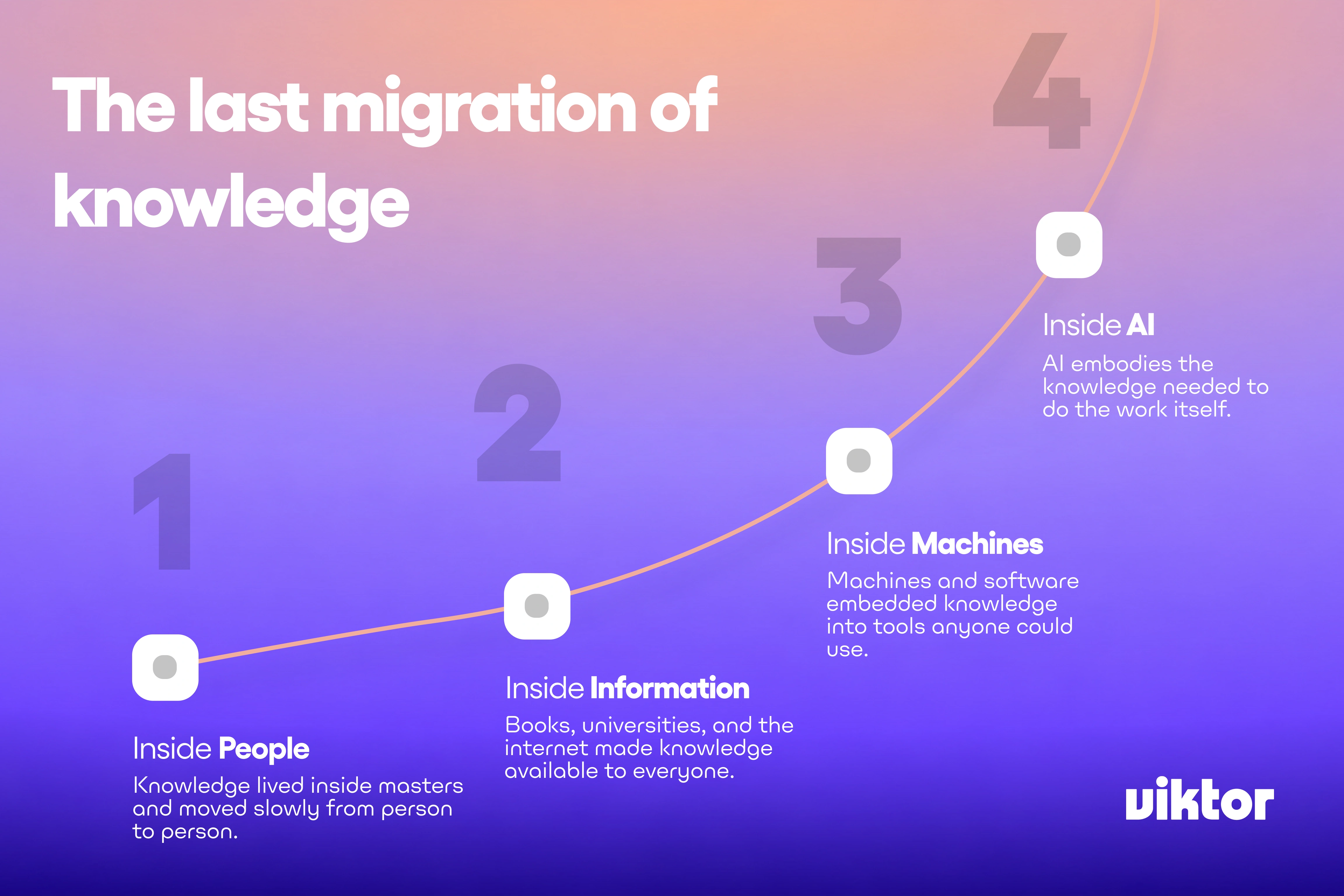
Each move carried knowledge further from the person who first had it.
For the first time, an expert can take the capability it took a career to build and pour it into something that does the work itself, without them. You hand it your real problem, your spreadsheet, your Meta Ads account, your customer's ticket, and it works through it the way they would.
The years it used to take to get good are no longer the price of a good outcome.
You walk away with the master's result, without ever having to become one.
Starting today, Viktor makes this possible with the Skills Library.
The world's best operators, the people you could never access or afford, can now package their expertise into Skills and share them with the world.
Add a Skill, and Viktor will execute that operator's playbook on your behalf, bringing their judgment and methods directly to your work.
Knowledge always wanted to travel.
For most of history, the farthest it could go was the nearest mind. But eventually it handed the work back to you.
You no longer have to become a master to get a master's work.
And the masters, for the first time, can be in a hundred thousand places at once.
Available on all plans.
